

If you’ve ever wondered whether you can learn to scuba dive as an adult, or worried it might be too difficult to pick up, you’re not alone, and the answer is more reassuring than you might think. Diving is a discipline pushed by the love of entering a completely new dimension and discovering a new world. The first requirement to dive is honestly love (sorry to be cheesy, but this is the truth). The second requirement is health, and once you have both, you have all the cards on the table to become a diver. Still, being completely new to it can feel intimidating, which is exactly why we wanted to write this article and answer the most common questions people have before learning to dive.
Can you learn to dive as an adult?
There is no maximum age limit to learn to dive as an adult. We have some guests here at Camel who are in their 70s or 80s, still going strong. One beautiful thing about diving is that it brings different generations together. Very often, younger people start diving because some adults in their family do it, but also the other way around. We get parents that learn to dive after being introduced to the discipline by their kids. Sometimes we get adults that want to face an irrational fear they have, to then totally fall in love with it. So, yes, you can learn to dive as an adult, as long as you want to.
Is diving hard to learn?
Learning to dive is not as hard as you think. Usually, the difficulty perceived is more psychological than physical. This is very personal, as we all come from different backgrounds and life experiences. For example, if someone is claustrophobic, they might have some issues at first getting comfortable around the idea of breathing with a regulator underwater. Our marketing manager, for example, did her first diving course because she wanted to face the fear of breathing underwater with a regulator, and she was quite an anxious diver at first, but then, with love, practice and the right instructors and guides, something clicked and she completely fell in love with it and now works for a diving business.
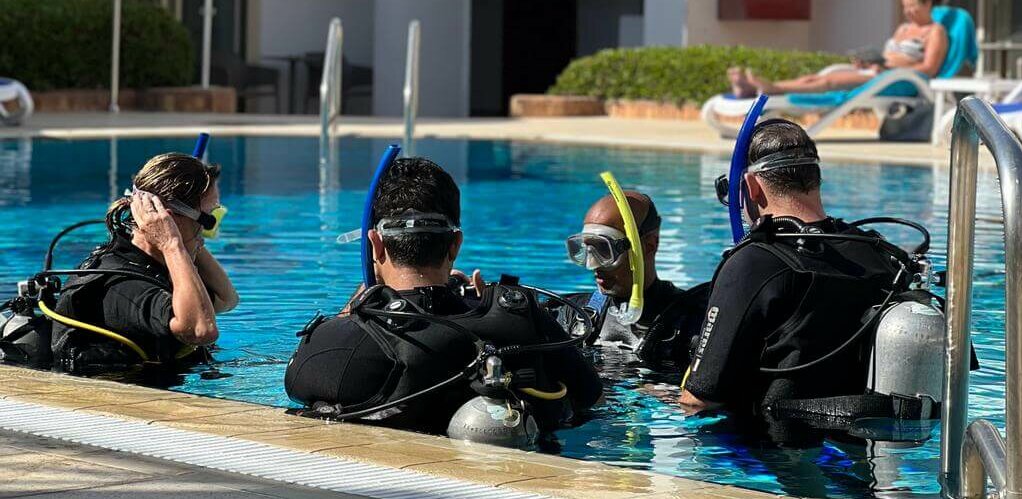
This story takes us to a very important point: when learning to dive, it’s very important who you do it with, because this can really affect your experience and future in diving, positively or negatively. We would lie if we said that there are no risks in diving, but, at the end of the day, like everything else in life. Safety is a big part of learning to dive, and choosing the right instructor and diving centre is key to delivering this. For example, during your Open Water Diver course, you have some theory to study independently, and then during your 3-day course you will put this into practice with your instructor. You start by trying the equipment and skills in a swimming pool or confined water, and then slowly and progressively you move into the sea or open water. A good instructor won’t rush this process just for the sake of giving you a certification and taking your money — they will make sure that you are truly ready before moving to the next step.
What if I am not a strong swimmer?
This is probably one of the most asked questions when learning to dive. It is not required to be an athlete to dive, but you need to be comfortable in the water. If you have never swum before, or you don’t feel comfortable in the water, you can still learn to dive, but it’s probably better if you take some time to familiarise yourself with water first. If you have access to a swimming pool or confined water, you can take some time to go and practice. If you really struggle but would still like to learn, the best way is always to take some lessons with an instructor. SSI offers Survival Swim, a programme designed to help people become comfortable in the water.
What if I get anxious or feel claustrophobic underwater?
As we mentioned earlier, the feeling of claustrophobia is one of the most common fears when going underwater. We are not here to say that this won’t happen, or that everyone finds it completely natural when learning to dive. However, as with the story from earlier of our marketing manager, it is completely possible to overcome it. How? Firstly, give yourself time. We are used to getting everything immediately nowadays, but we need to remember that we are literally diving into a new dimension, with new rules. Something that, biologically, we weren’t made for. For some people it will be quicker, and for others it will take a bit more time, but eventually, if you give yourself time and you are truly passionate, it will unlock. Second of all, your breath is your best friend. Learning to have relaxed breathing underwater is part of your path to learning to dive. Eventually, this will help you relax more. Finally, knowledge. We are usually scared of things we don’t know, so the more you learn and practice, the less anxious you’ll be, and the more confident you’ll become.
Health checks before you dive
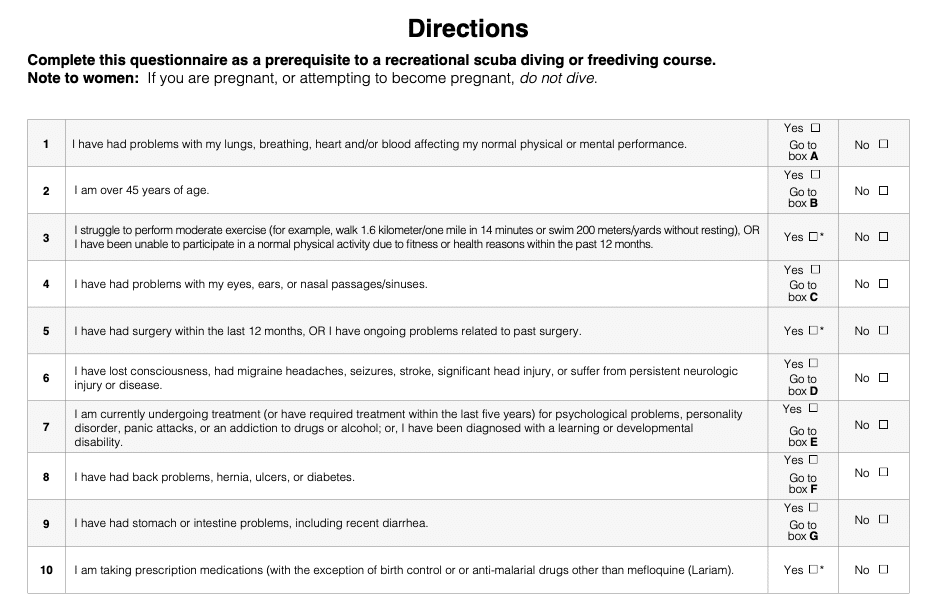
Now that we have covered the irrational blocks when it comes to diving, we can talk about health. It is very important to evaluate your personal health before diving, to avoid any emergency situations. Before you take any diving course or trip, you will be asked to complete a diving medical questionnaire about your general health. You can find an example below.
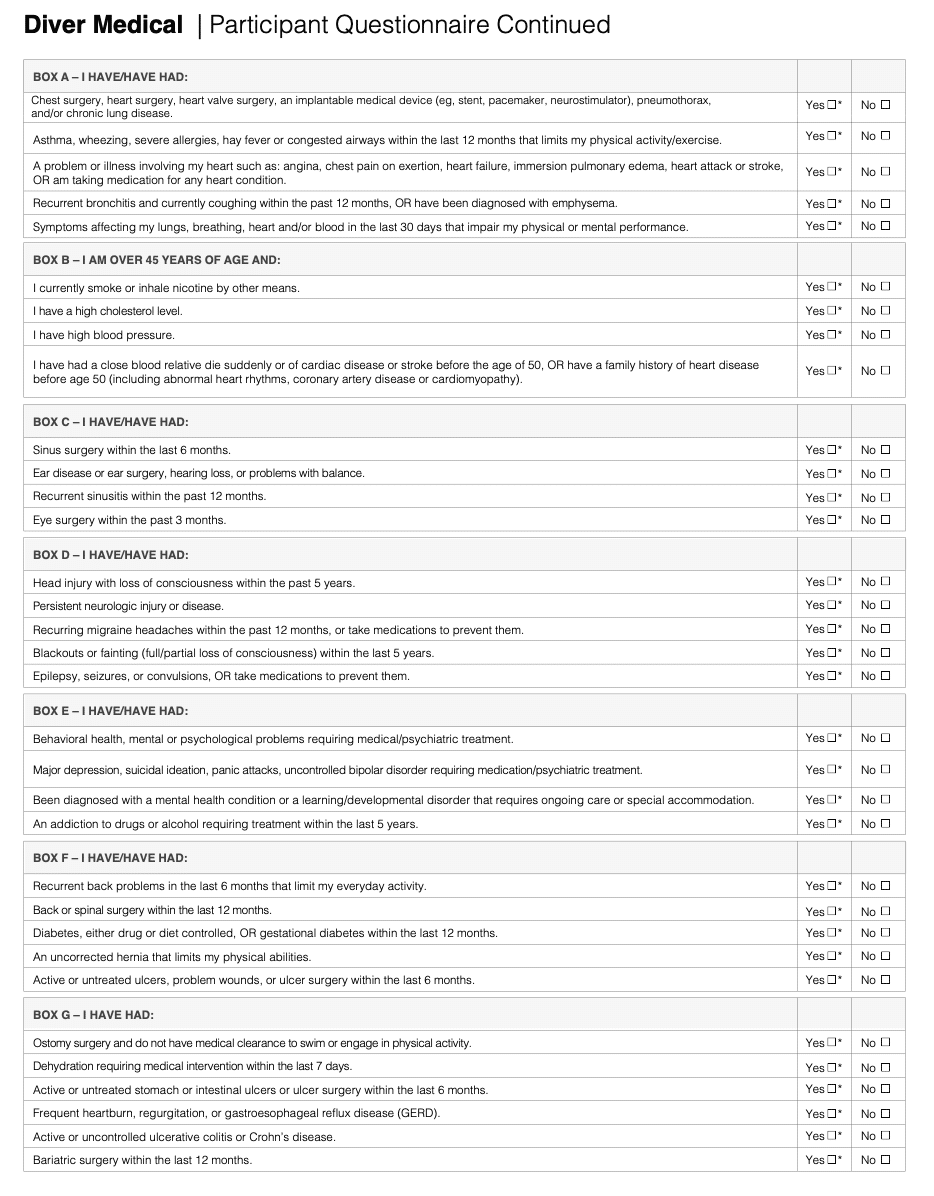
Asthmatic people should get a professional check-up before diving, as it is usually not recommended without one. If you have active congestion or sinusitis, you should never dive, as you will have problems with pressure and equalisation.
Ear pain is one of the most common issues beginners face, but it is almost always about technique, not health. As you descend, the pressure around you increases, and you need to equalise your ears (usually by gently pinching your nose and blowing) to avoid discomfort. This is something your instructor will teach you properly during your course, step by step. The golden rule is: never force it. If your ears don’t clear, stop, go back up a little, and try again. Diving through ear pain is the one thing you should never do.
If you wear glasses or contact lenses, this shouldn’t stop you either. Contact lenses generally work fine underwater with a standard mask, and if you’d rather not deal with them, most dive masks can be fitted with prescription lenses, so you can see the reef just as clearly without them.
Menopause is something we don’t see talked about enough in diving, even though it’s relevant to a good number of the women who come through our doors. Hormonal changes can affect things like temperature regulation, buoyancy, and joint comfort, but they are not a reason to stop diving or to think you can’t start. As always, if you have any doubts, a quick chat with your doctor before your course will give you peace of mind.
Ready to try it for yourself?
If you’ve read this far, chances are you already know the answer to your own question. Age isn’t the barrier you thought it was, being a strong swimmer isn’t a requirement, and the fears that feel so big on land tend to shrink the moment you’re guided through them properly, one step at a time. The only thing left to figure out is what it actually feels like, and that’s not something anyone can explain to you in words.
The SSI Open Water Diver course is where most people start: three days, and you come out with the certification that lets you dive anywhere in the world. If that still feels like a big commitment, you can begin with the SSI Scuba Diver course instead, the step before Open Water, and try diving properly under supervision. If you fall in love with it (which, honestly, most people do), you can simply continue on to your Open Water Diver certification whenever you’re ready.