

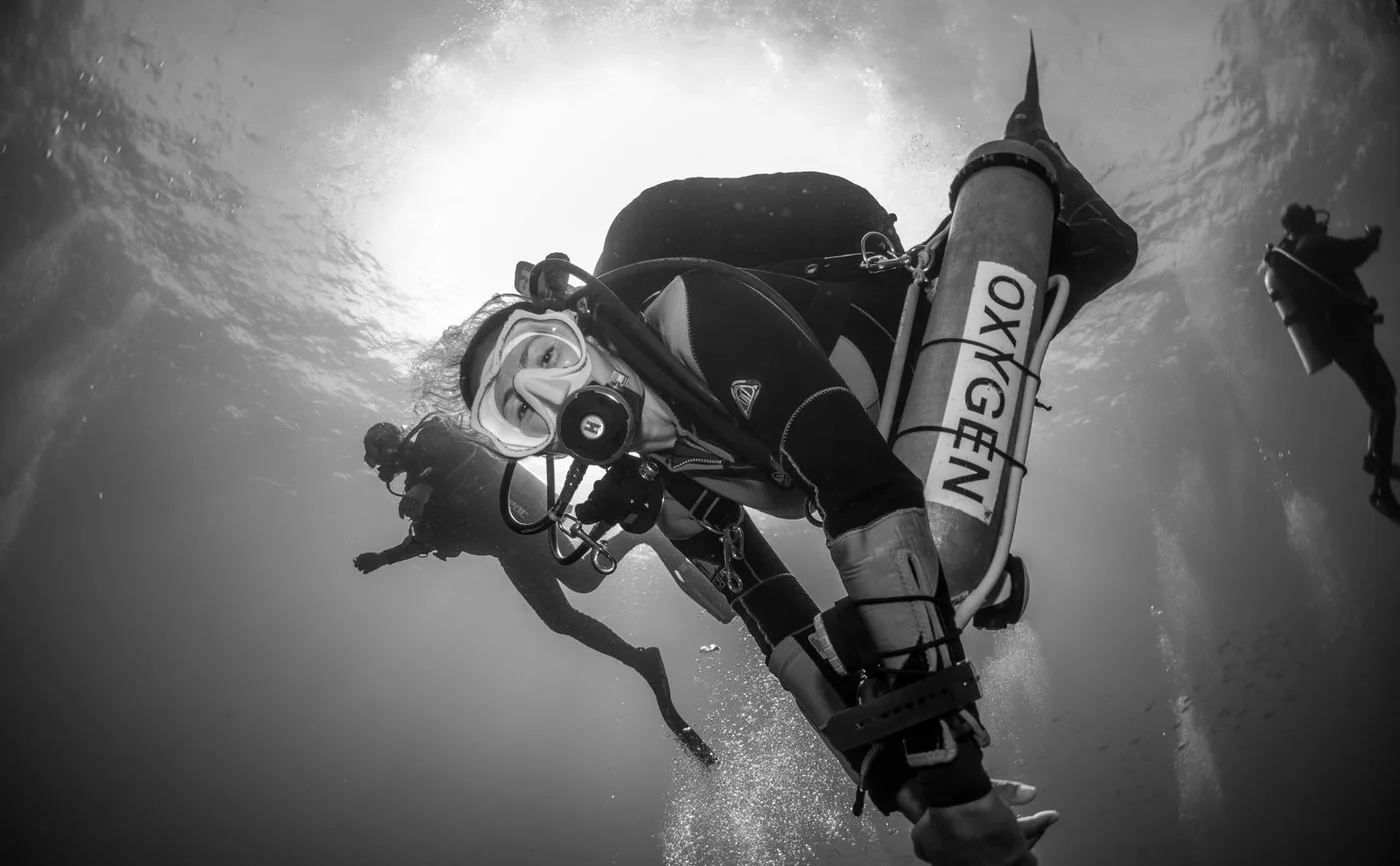
What really changes when an experienced diver becomes an instructor? We asked the team of Camel instructors to share what teaching has taught them about diving, responsibility and the people they meet underwater.
At some point, logging more dives stops being the only way to move forward. You may still want to travel, discover new dive sites or add specialties to your certification card. But for some experienced divers, another question starts to appear: could I teach someone else to do this?
Becoming a scuba instructor is very different from taking another recreational course. You are no longer developing skills purely for yourself. You are learning to watch another diver closely, understand what is happening and decide when that person is ready to progress.
At Camel Dive Club, we have seen divers make that transition throughout our 40 years in Sharm el Sheikh. So rather than trying to describe the job from the outside, we asked our instructors about it.
Their answers are not identical. That is precisely the point.
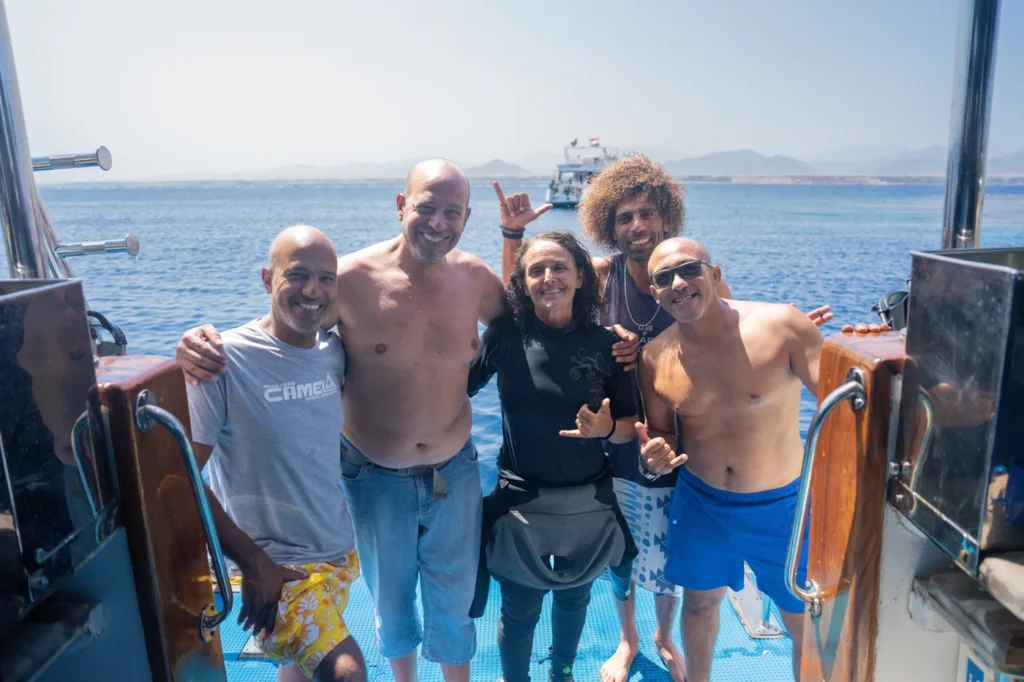
What comes after Open Water if you want to become a scuba instructor?
Becoming an instructor does not happen immediately after Open Water certification. The dives, courses and experience that follow are part of developing the judgement and diving ability you will eventually need as a professional.
Within the SSI professional pathway, Divemaster is the qualification required before entering the Instructor Training Course, or ITC. An equivalent professional qualification from another recognised training agency may also be accepted.
Under current SSI training standards, candidates entering the ITC need at least 75 logged open-water dives totalling 50 hours of dive time. The course has a recommended duration of 70 to 80 hours and combines academic work with confined-water and practical training.
Completing the ITC is not the final step. Candidates then attend an Instructor Evaluation, where their ability to teach and manage diver training is assessed independently. By completion, candidates must have at least 100 logged open-water dives totalling 65 hours of dive time. They must also have held an Open Water Diver certification, or higher, for at least 6 months.
Once the Instructor Evaluation has been successfully completed, the candidate can qualify as an SSI Open Water Instructor.
At Camel, professional training takes place within our SSI Diamond Instructor Training Center in Naama Bay, with our 4-metre training pool on site and the Red Sea a few minutes away.
Why become a scuba instructor in the first place?
There is no magic number of dives at which someone suddenly decides they want to teach.
For Sayed Salem, the decision grew out of his experience working as a Divemaster.
“I decided to become a dive instructor because I really liked the work. The experience I gained as a Divemaster made me want to improve my knowledge and professional skills and become a good instructor. In my opinion, it is the best job you can do here in Sharm.”
That enthusiasm is familiar to Alessia Ravarotto, but she is quick to point out that turning diving into a profession changes much more than the name on your certification card.
“If you decide to become a diving instructor and make your passion your job, you are a lucky person. You meet people from different nationalities and live a life in contact with nature and marine life.”
Then comes the other side of the story.
“As a diver, you are responsible for your own safety and you check on your buddy. As an instructor, your radar has to expand to 360-degree awareness. You need to anticipate problems before they happen.”
For Alessia, that also means developing patience and self-control while learning to manage fear, anxiety and unpredictable reactions underwater. And there is a decidedly less romantic side to the profession.
“It truly is a labour-intensive job. Carrying tanks, loading equipment and moving weights is the unglamorous side of the ‘best job in the world’. You also have to consider the lifestyle. Depending on where you work, you may need to travel or relocate. Consider all sides, and if you can manage them, welcome to the club!”
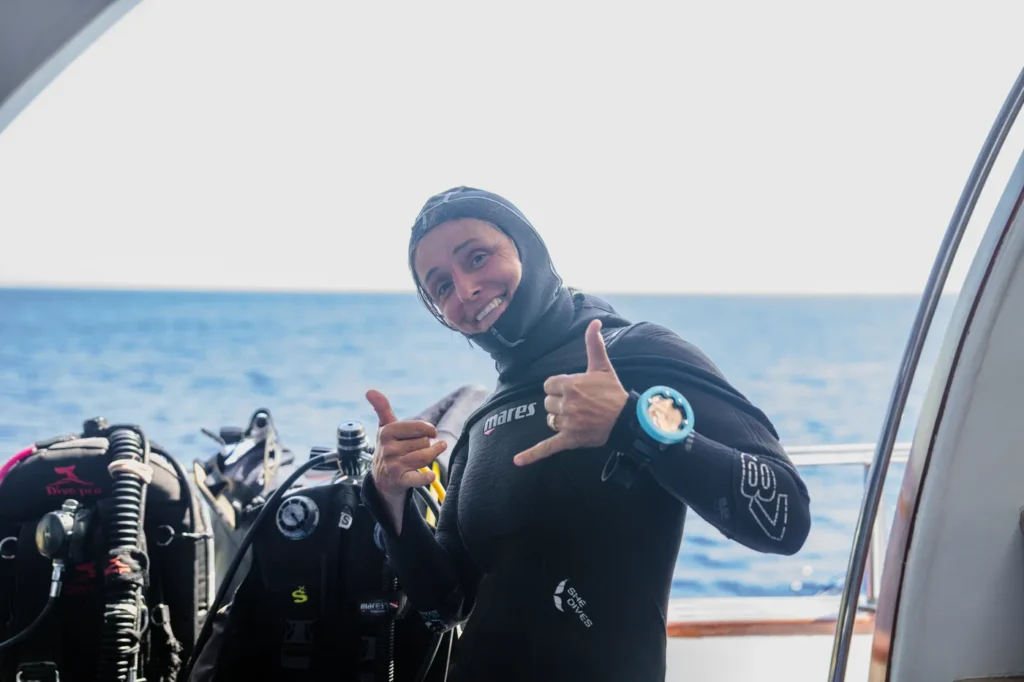
What is the hardest part of teaching new divers?
Ask several instructors this question and one word comes back repeatedly: confidence.
Fahd Mahmoud sees confidence and buoyancy as two of the most common difficulties for new divers.
“I try not to rush them. I give them time to practise and learn through repetition.”
Mostafa Mohamed sees a similar problem, particularly when students struggle to trust what they have already learned.
“I help them by giving a clear briefing about the dive plan and then following that plan. Afterwards, we debrief and talk about what they need to work on. That helps them build the confidence to dive correctly.”
For Hana Pekarkova, buoyancy can become particularly frustrating when a beginner starts comparing themselves with divers who have far more experience.
“They keep comparing themselves to more experienced divers, and that can make them feel frustrated. In that case, we may suggest a private guide or the Perfect Buoyancy specialty so they can work one-to-one with an instructor. Once they experience that feeling of weightlessness and understand how to control it, their confidence improves dramatically.”
The common thread is time. Skills can be demonstrated in minutes. Becoming comfortable with them may take longer, and different students need different approaches.
Does teaching change the way you dive?
According to Abdallah Fathy, teaching other divers and helping them solve problems has changed his own confidence and experience underwater.
“Teaching divers and helping them solve their problems gives me more self-confidence and experience. Seeing people happy makes me happy too.”
Ali Hassan describes a similar change, but one that goes beyond diving technique.
“Teaching diving changed a lot about me. It taught me patience, responsibility and confidence. It also showed me how much I can grow when I help someone else overcome their fears.”
For Francesco Pipino, the shift becomes visible in where an instructor looks during a dive.
“When you start diving, you are mostly focused on yourself: your buoyancy, your equipment, your air consumption and what you are going to see next. After thousands of dives and years of teaching, your attention naturally becomes wider.”
He still looks for interesting marine life and gets excited when he spots something unusual. But part of his attention is elsewhere.
“I spend much more time watching people: their breathing, trim, body position and, above all, how comfortable they really are. Sometimes ‘I’m fine’ and what you see underwater are two very different things.”
Teaching has also changed his definition of a successful dive.
“A great dive isn’t necessarily the one with the biggest shark or the rarest creature. Sometimes it’s simply the one where everyone comes back to the boat with a big smile.”
And when an instructor finally goes diving on holiday?
“I just dive. New places, new reefs, new creatures, meditation dives. It’s like a surgeon going on holiday and doing a few operations anyway, because he loves surgery.”
Which students stay with an instructor?
An instructor may teach hundreds of people, but some students remain remarkably easy to remember.
For Claudio De Cesaris, the memorable part is often not one dramatic event.
“For me, every course is special. I like to see the smile growing in their eyes after every dive. More confidence and more practice, with the right holiday mood, can build a happy diver.”
Mohamed Maher remembers one student in particular: Naren Bhowal.
Naren initially found some of the required skills difficult. His age and physical condition meant that learning them took time, but Maher remembers his persistence more than the difficulty itself.
“What caught my attention was his persistence in completing the skills. I saw his tears after completing his Open Water course and how happy and proud he was.”
Only afterwards did Naren admit something to him.
“He told me that he hadn’t been happy with me from day one. But he continued working with me because his sister, who had around 700 dives, had told him to. I will never forget what she said to him: ‘This person you are complaining about is the one you should trust.’”
Today, Naren has fewer than 50 dives. Maher has watched what happened after the course too.
“Seeing Naren now makes me proud and reminds me who we are. We are dive instructors. Our job is to make better divers.”
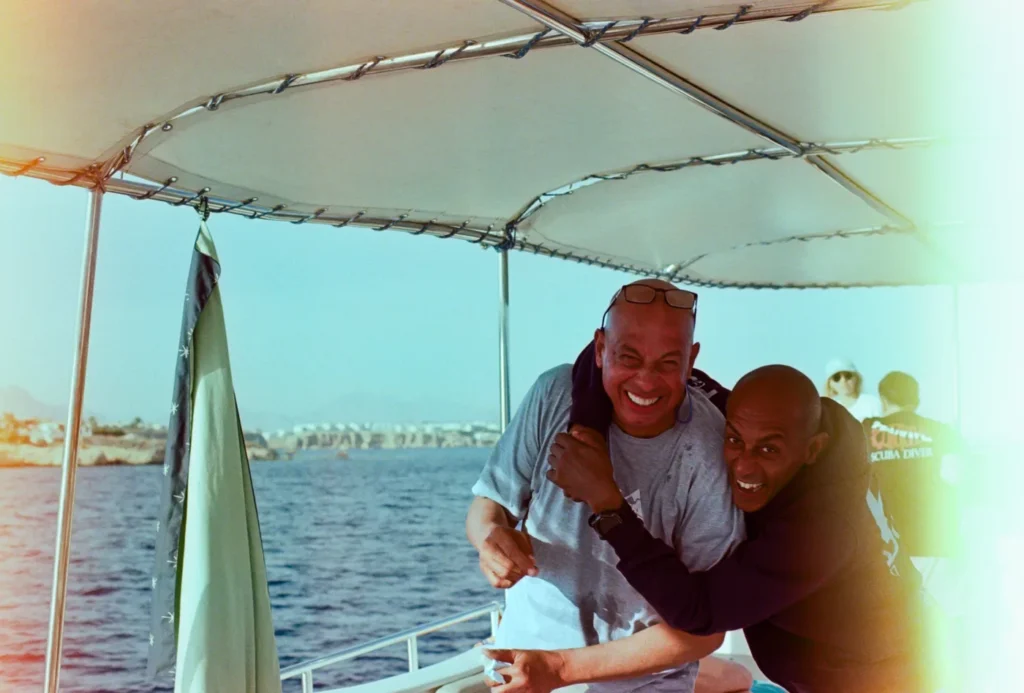
Should every experienced diver become an instructor?
No. Experience alone is not enough, and our instructors were particularly clear about this.
Ahmed Mohamed puts it plainly:
“If you are not confident in yourself, do not undertake this. If you do not love diving and you lack the necessary patience, do not do it. And if you do not enjoy every single dive, do not pursue it.”
Fady Shawky approaches the same decision from the other direction.
“If diving is something you truly love, becoming an instructor can be an amazing next step. You can share that passion, inspire others and help them discover the underwater world. It’s a big responsibility, but if you’re ready to grow and lead, go for it.”
Between those 2 answers lies much of what actually changes when a diver becomes an instructor.
The qualification is important, of course. So are the logged dives and the training. But the job begins when your attention moves beyond your own dive and towards the person who is learning from you.
Camel Dive Club has been training divers in Sharm el Sheikh since 1986. Today, as an SSI Diamond Instructor Training Center, we can take that training into the professional pathway.
If becoming a scuba instructor has been sitting somewhere in the back of your mind, talk to our team. We can look at the qualifications and experience you already have and tell you what your next step would actually be.
Becoming a Scuba Instructor: FAQ
You need at least 75 logged open-water dives totalling 50 hours to enter the Instructor Training Course. By the end of the Instructor Evaluation, you need at least 100 logged open-water dives totalling 65 hours.
The ITC has a recommended duration of 70 to 80 hours. It combines academic work with confined-water and practical training, and it is followed by the Instructor Evaluation.
Yes. Within the SSI professional pathway, Divemaster is the qualification required before the ITC. An equivalent professional qualification from another recognised training agency may also be accepted.
Yes. Camel is an SSI Diamond Instructor Training Center in Naama Bay, with a 4-metre training pool on site. Our team can look at the qualifications and experience you already have and tell you what your next step would be.
Thinking of going pro? See how our instructor training works.