

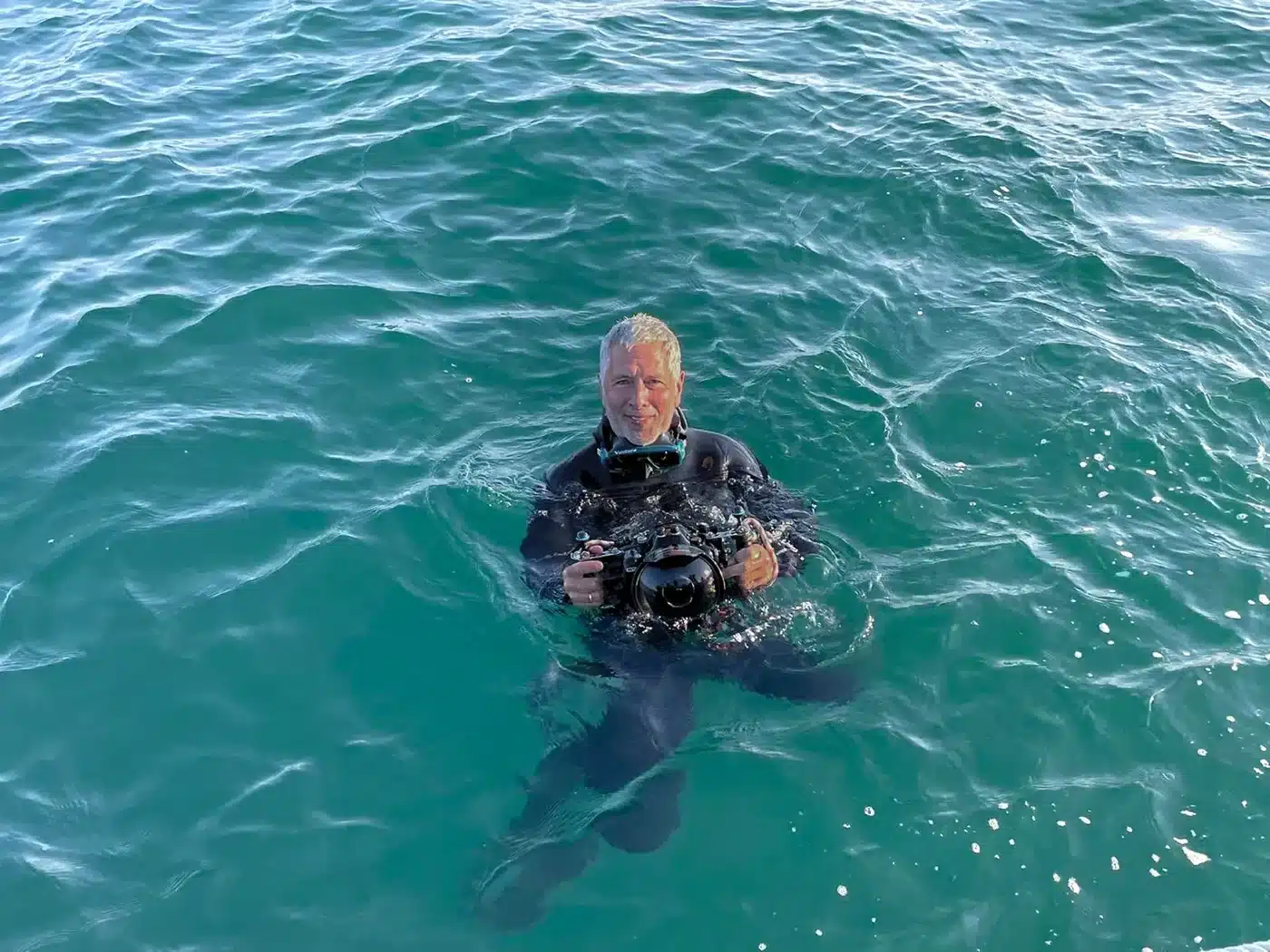
Welcome to Surface Interval, our new blog series. Every diver knows the surface interval: the time between two dives, back on the boat, when the best conversations happen. This series brings that time to the blog. We invite friends of Camel and guests from the diving world to sit down with us and talk about what they know best.
For our first Surface Interval we are really excited to welcome Vasco Pinhol. He is a long-time friend of Camel, but before that he is an underwater storyteller. With him we talk about underwater photography storytelling: how a photo goes from a nice holiday memory to a story other people can feel. So grab a coffee and pull up a chair.
Meet Vasco Pinhol
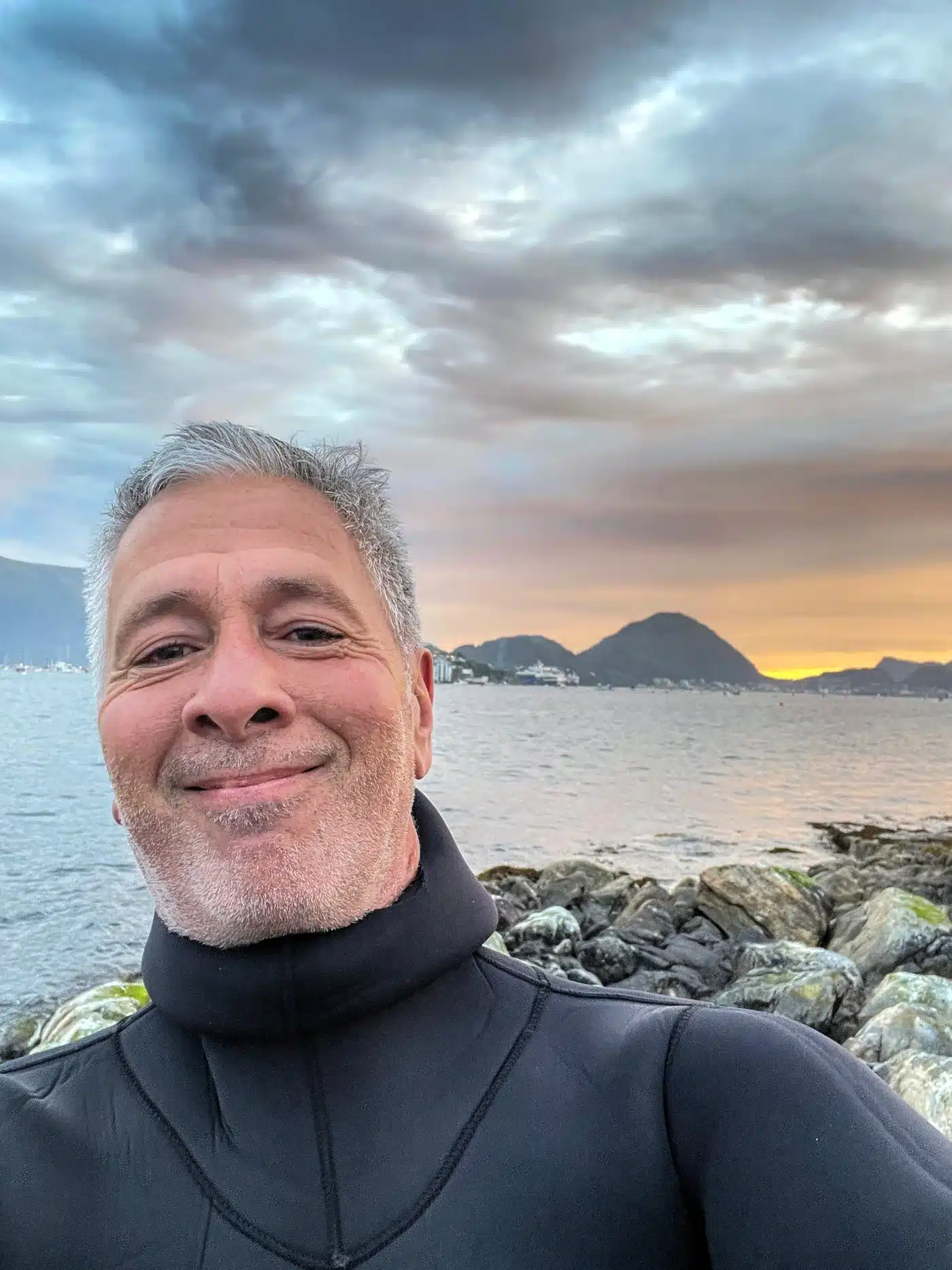
Vasco was born in 1962. He has been taking photos since 1970 and shooting underwater since 1980. He has logged thousands of dives, and he led the jury of our Underwater Stories photo and video competition, helping us put that jury together. His own bio is short: “Still trying to do my best.”
We started where every good conversation starts.
So, Vasco, how would you introduce yourself? And when did you start thinking in stories rather than single images?
I am happier in the water than out, ever since I was a kid. That is what I’ve been, that is what I am still. I started photographing my first experiences with cameras when I was 8 and with underwater photography when I was 18.
I’ve always approached single images as stories. Early on, I was told about Cartier-Bresson’s decisive moment in a photo, the moment that will, over all others, be the one that tells the story. I’ve always been more interested in photographing what I feel, rather than what I see.
A beautiful photo or a photo that tells a story?
Every day we scroll past hundreds of images. Most of them we forget in a second. A few make us stop, look again, maybe even feel something. So we asked Vasco what makes the difference.
What is the difference, for you, between a beautiful photo and a photo that tells a story?
The first is typically documental and it has its own contextual value. It might be very important as a tool to motivate, via beauty, people to come to the sea or to protect it. To me, a photo that tells a story promotes empathy, which is the most human of the human emotions.
Could you show us two of your own photos that tell a story, and share the story behind each one?
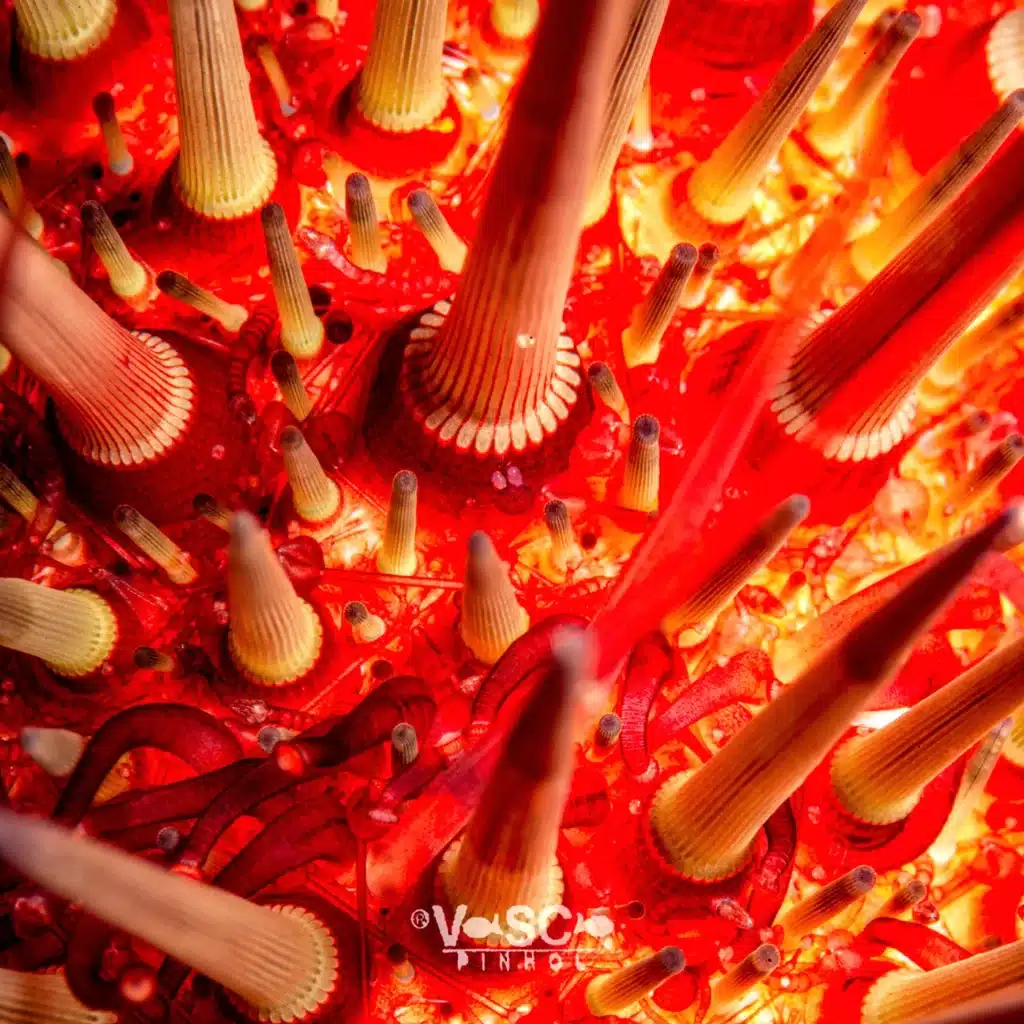
His first pick is a sea urchin: “How a sea urchin looks, up (very) close and (very) personal. The beauty of finding absolute symmetry on small things.”
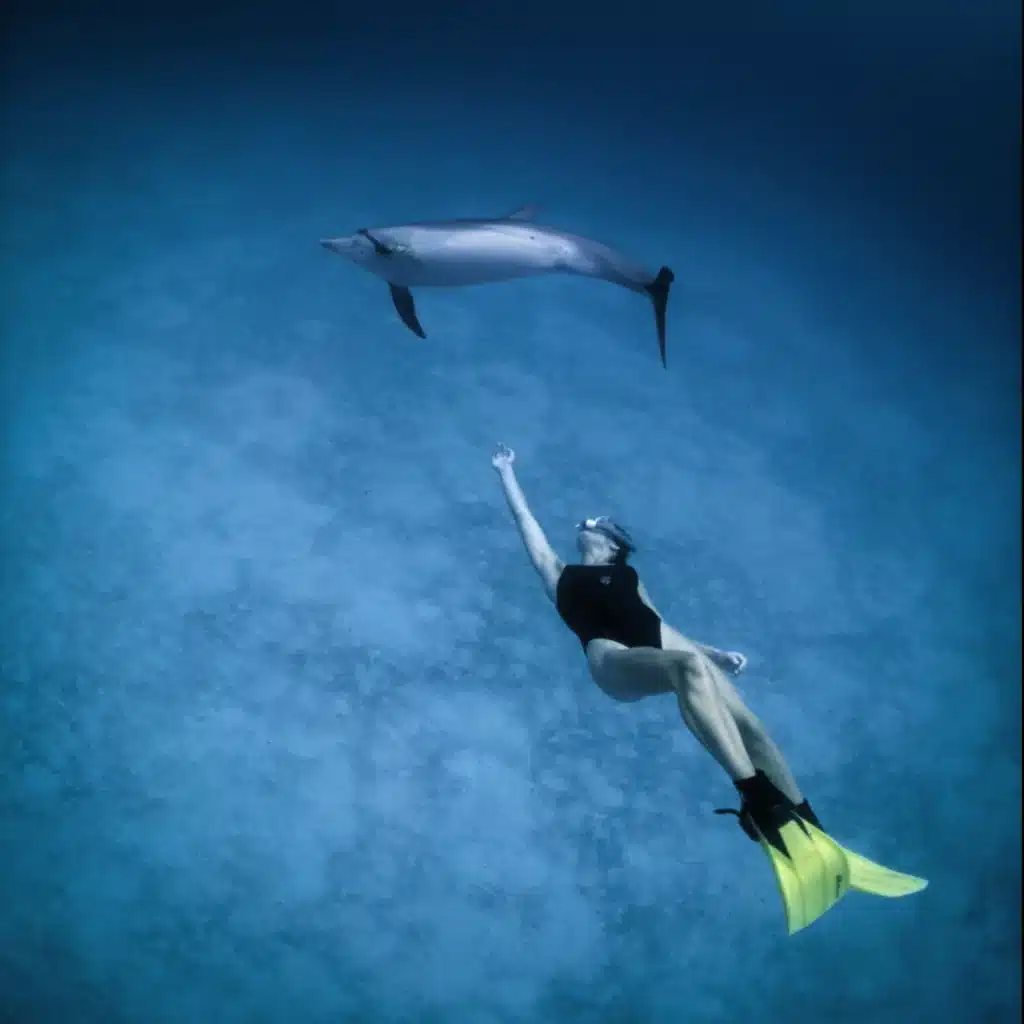
His second pick comes from a day with dolphins, and a moment nobody could have planned. In it are Erika, his wife, and a very special “friend”.
Erika and a friend, playing underwater rugby. Erika was, at the time, world champion of Underwater Rugby (Norwegian National Team) and her friend here got that, and teased her with a piece of algae (note it, on left pectoral fin). There were more dolphins enjoying this game, which went on for quite some time. It was epic, and, I believe, unrepeatable.
Building a story across a single dive
Most of us plan a dive around depth, time and air. Very few of us plan the story. Should we? Or is the sea too unpredictable for that?
Do you plan your story before getting in the water, or does it take shape during the dive?
Both. The ocean only will give us what it wants to give us. I believe that one should always come into the water primed to see. After all these years, I do have an adequate command of what I might find in all conditions and in all environments, but, fundamentally, I stay humble and accept what the ocean gives me.
When you come into the ocean primed to see the magic of little things while being prepared to shoot the spectacle of big things, you will be ready to tell your story.
In short: no shot list, but open eyes.
One sequence, from start to finish
Then we asked for an example. One sequence with a beginning, a development and an ending, and what he was thinking along the way. Vasco chose a short video from a cold water dive in the fjords of Norway. Here he is both the protagonist and the storyteller, and the words on screen are his.
Sometimes it can be very satisfying to tell the story that your own very personal emotions play within the realm of your brain. In this I had to play myself as the protagonist as well as the story-teller, and used very impressionistic and even surrealistic frames to punctuate what I was feeling as I evolved in a cold water dive in the fjords of Norway.
The only mistake that matters
Taking a camera underwater for the first time can feel a bit overwhelming. Suddenly there is a lot to think about: your buoyancy, your buddy, the settings, the light, the fish that will not stay still. It is easy to worry about getting everything wrong. So we asked Vasco what he sees most often in people who are starting out. His answer surprised us.
What mistakes do you see most often in beginners?
The only mistake I see is the unwillingness to make mistakes and pay true attention to them. One learns exponentially more from one’s mistakes than from one’s successes. There are no real mistakes, only steps to development of the personalized way of seeing, to find one’s signature in imaging.
He also thinks mistakes will matter even more in the years ahead.
In these days of AI slop, I believe that the photographic error will become very important in the semantics of future imaging. We will spend energy looking for truly human artistic expression that won’t be trying to beat AI image generation at perfection. That will also apply to filming.
We will always prize more human-produced content than we will prize machine-generated imaging.
And what’s one thing you wish someone had told you at the beginning?
“Nobody cares.” Then he adds: “But I learned it very quickly.” Harsh? Maybe. It also takes a lot of pressure off.
Do you need expensive gear to tell a story?
When you start taking underwater photography or filmmaking more seriously, one of the first questions is gear. Professional equipment can be very expensive, so where do you draw the line? At some point you simply have to start with what you have, or what you can afford. So is an action camera or a phone in a housing enough to begin with?
Can a diver tell a real story with a GoPro or a phone in a housing?
“Absolutely,” says Vasco. Most of the images that shaped our shared history were shot on cameras far simpler than anything you can buy today.
Choose your tool, master its functions, dive-dive-dive. Your most important basic gear is your brain. Nurture it with inputs from other forms of art, form your (for lack of a better word) taste for what your brain perceives as “beautiful things”. Learn the basics of human perception and empathy.
For filming, take time to learn real skills of post-editing. Shooting video is only 5% of the job. The main creativity lies in editing and bringing the footage to final-cut.
For photography, read books, listen to music, visit museums. Also, embrace learning. The best videographer’s tool is “sleep over it and restart”; the best photographer’s tool is the garbage bin.
And where is it not worth spending money at the start?
“Booze and cigarettes.” We did say he keeps it short.
Respecting the reef while you shoot
There is one side of underwater photography that worries anyone who loves the sea: the photographer who kneels on coral or chases a turtle for the perfect angle. At Camel, reef protection is part of how we dive, so this answer mattered a lot to us.
Are there rules you never break, even for the perfect shot?
Never, ever, leave your mark. Be mindful that whatever you touch will probably die. Or will maim or kill you. Learn positive stealth. Be skilful at your positioning. Learn to read the currents, the sea. Be humble. Clean up after yourself. Be humble. Learn from the fishes.
Why the Red Sea is different for storytellers
Before wrapping up, we wanted to hear about your experience in diving in the Red Sea.
What makes Sharm and the Red Sea special for underwater storytelling?
Vasco answered with a comparison we did not expect: the desert.
My first travels through the desert (in the Sahara) were rather confusing in the first days for its nothingness, for the lack of things to see. After the initial period, I realized that in the desert one is forced to look inwards and discover what lies within.
The Red Sea has the opposite problem: once one drops into the water the myriad distractions and the countless little stories that one sees developing everywhere make the whole experience rather distracting. It takes a few days of exposure to carve a path to choices of “what stories to tell”.
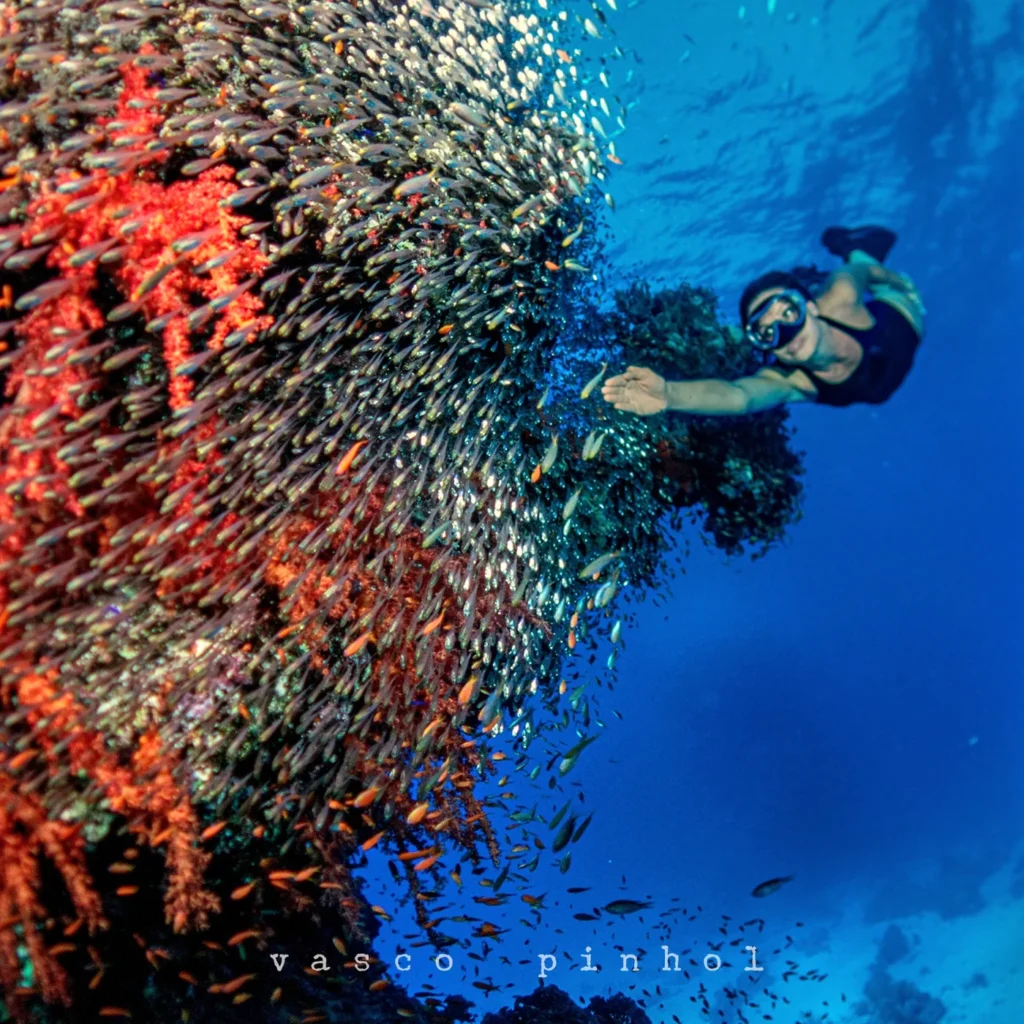
Even after thousands of dives, his rule for the Red Sea is simple: “expect to be surprised, be ready to make the best of it”.
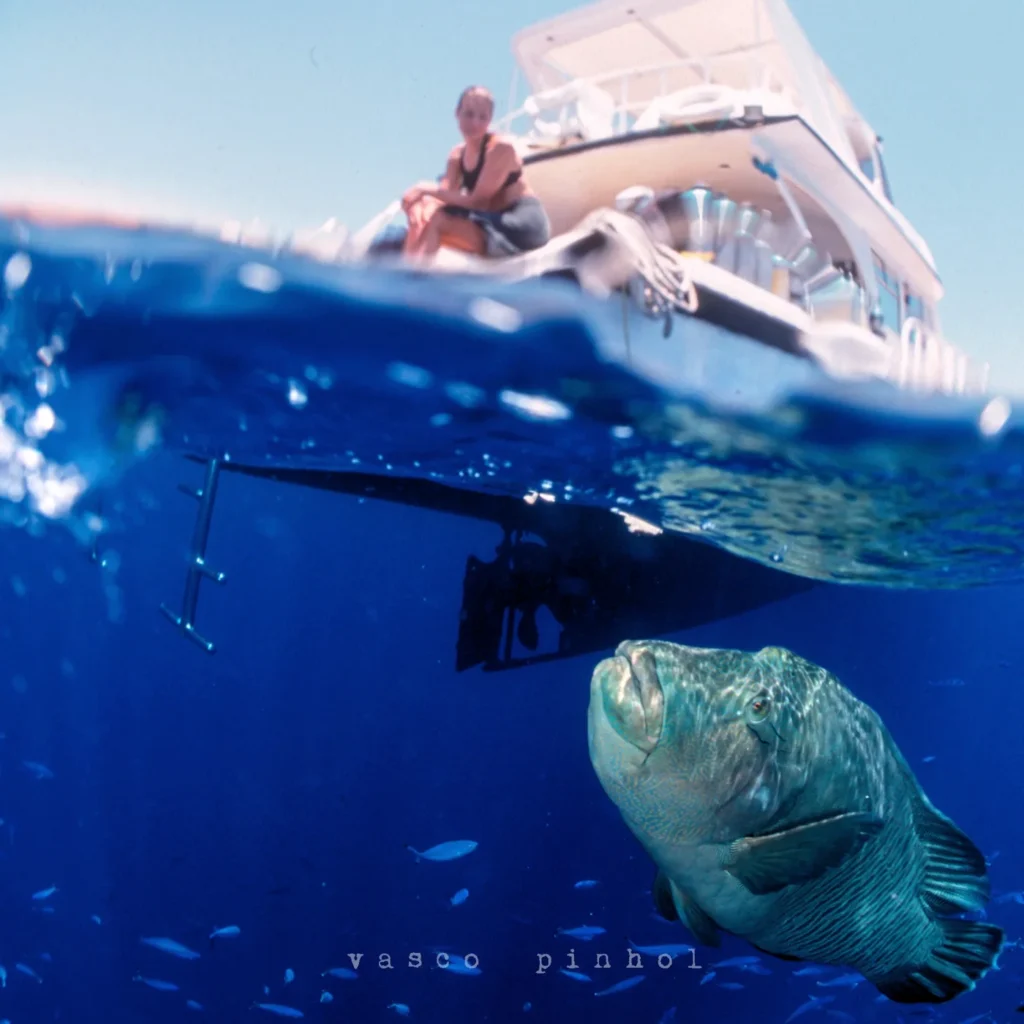
Is there a subject you keep coming back to?
In my personal case, I am always coming back to the magic of small things, the little dramas that survival within a very densely populated ecosystem create every moment of the day. But always carry a wide-angle camera when you’re shooting macro, and always carry a macro camera when you’re shooting wide-angle.
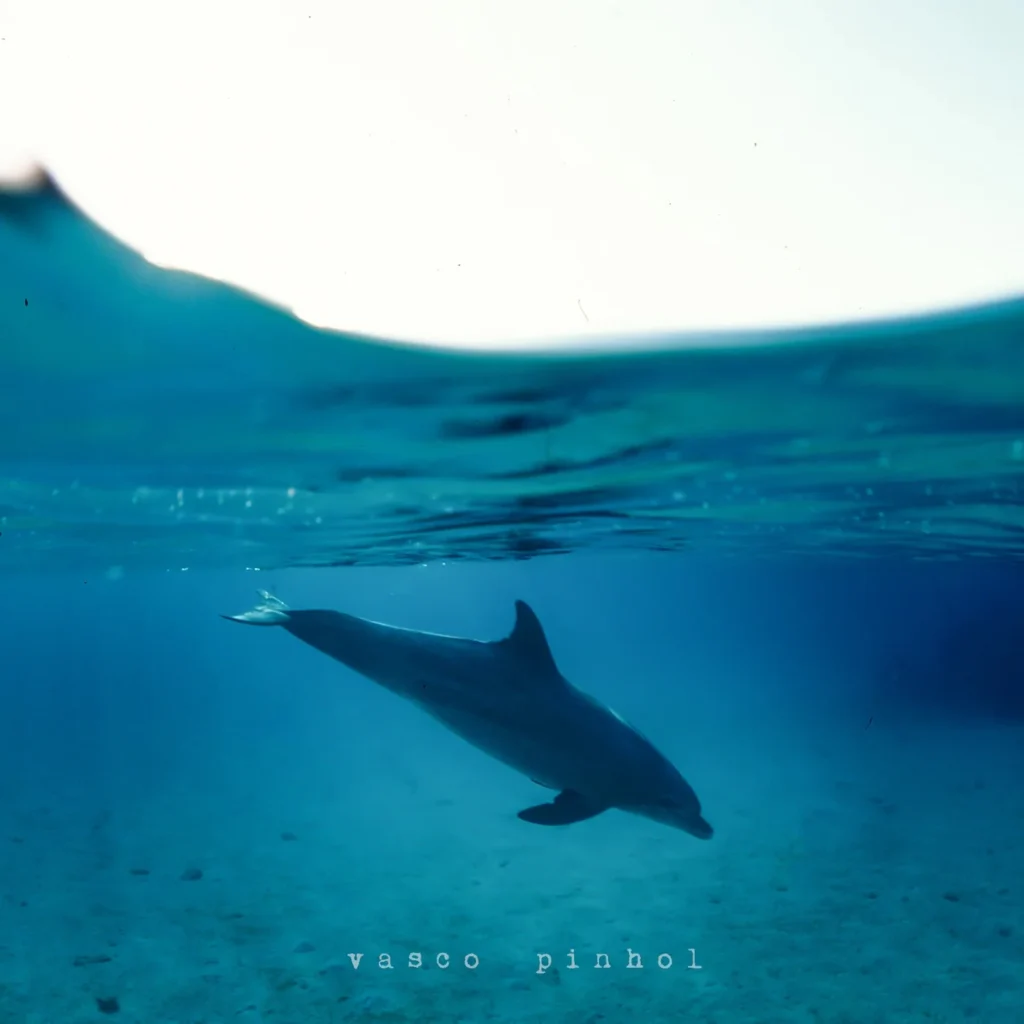
One last photo, and one last story from Vasco:
This girl was pregnant, and given that girl dolphins last up to 60 years in the wild, she’s still probably around there.
One exercise for your next dive
To finish, we asked for something practical. One exercise anyone could try on their very next dive.
If readers could try just one exercise on their next dive, what would it be?
Stop what we call “safari photoshooting” and try to be with the reef instead of swimming through it. Choose a spot and stay in it long enough to start noticing what is going on around it. Move less. See more. Take in the action instead of being the action.
Until the next Surface Interval
We are really grateful to have had Vasco as the first guest of Surface Interval, and we hope this conversation gave you something to take on your next dive. Every Surface Interval will bring a new guest and a new topic. Some will be about diving, others about the Red Sea, the reef and the life around it.
To see more of Vasco’s work, visit his Instagram, Trolltegn and his photography and film CV on Photoceania.
If this has made you want to tell your own stories underwater, the good news is that it is more accessible than you might think. There are plenty of tools available today. Talk to people who already have experience. Start with the camera you have. Learn the technical basics of photography and videography (if video is more your thing), and how light works underwater.
Training yourself as a diver matters just as much as training with the camera. Good buoyancy and feeling comfortable in the water make every shot easier, and they keep the reef safe while you focus on your frame.
And if you would like someone by your side at the start, there are two good first steps: our SSI Photo & Video specialty for the camera, and the SSI Perfect Buoyancy specialty for your control in the water. However you begin, the reef is full of stories. Move less, see more, and you will start finding them.